


Two Systems That Should Talk to Each Other But Don't
Your CRM is the system of record for customer relationships. Your cloud marketplace is where transactions actually happen. In most ISV organizations, these two systems do not talk to each other. The gap is filled by spreadsheets, manual exports, and institutional knowledge.
Five Revenue Problems from Disconnected Systems
- Manual data entry errors: Contract dates entered wrong, ACV in wrong currency, account associations under wrong CRM account. Small errors compound into large reporting problems.
- Missed renewals: When CRM and marketplace renewal dates diverge, teams operate on incomplete information. First signal is often a customer escalation.
- No attribution: Without clear channel attribution, you cannot measure marketplace ROI or answer "how much ARR is marketplace-sourced."
- Usage data stays siloed: Account managers make renewal and expansion decisions based on gut feel rather than actual consumption data.
- Fragmented customer view: AEs and account managers living in CRM have a systematically incomplete picture of the customer.
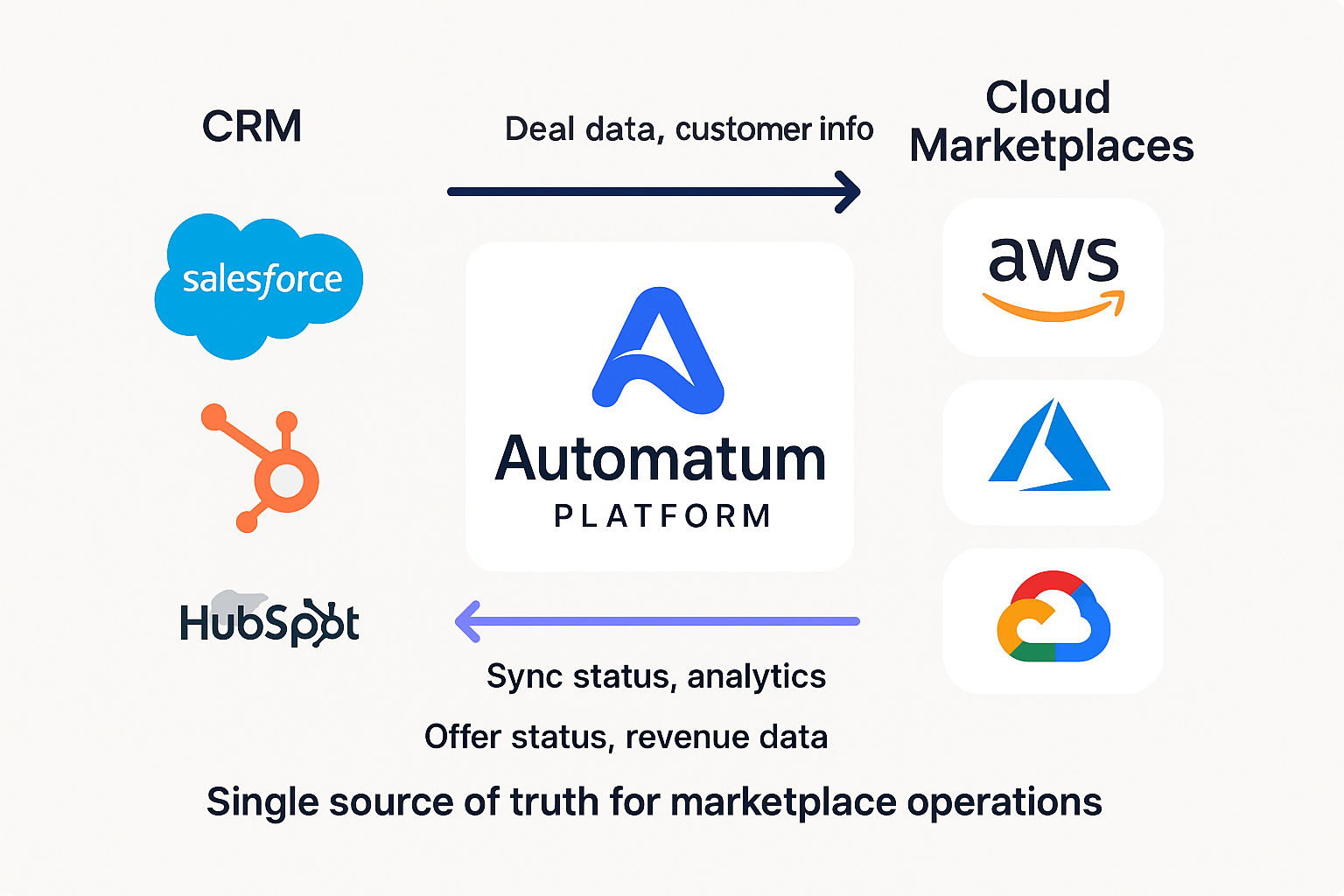
What the Connected State Looks Like
When a customer accepts a private offer, the CRM is automatically updated: opportunity moves to Closed Won, contract value recorded, dates captured, marketplace attribution set. Approaching renewals surface as tasks automatically.
Usage data flows into customer records for real-time visibility. Every transaction is tagged with channel, marketplace, and co-sell involvement.
Salesforce Integration
- Automatic opportunity updates from marketplace events
- Custom marketplace fields on Account and Opportunity objects
- Renewal task automation based on subscription expiration dates
- Usage data sync for metered subscriptions
- Co-sell pipeline data surfaced alongside CRM opportunities
HubSpot Integration
- Deal pipeline updates from marketplace subscription events
- Contact and company enrichment with subscription data
- Renewal workflow triggers based on expiration dates
- Revenue reporting with marketplace channel attribution
How Automatum Connects the Systems
Automatum acts as the integration layer between your CRM and all three cloud marketplaces. It receives marketplace events, normalizes them into a consistent data model, and syncs relevant data to Salesforce and HubSpot through native integrations.
The sync is bidirectional: marketplace events flow into CRM, and CRM actions can trigger marketplace workflows.
Making the Internal Case
- Risk reduction: Even one missed renewal can cost more than the integration
- Headcount efficiency: Eliminate low-value manual data entry
- Revenue attribution: Protect marketplace budget justification
- Sales effectiveness: Complete customer data means better decisions
Automatum simplifies cloud marketplace operations across AWS, Azure, and GCP.
Book a Working Session →Frequently Asked Questions
Common questions about the topics covered in this guide.
Why should I connect my CRM to cloud marketplace?
Without CRM integration, marketplace deals exist in a separate system from your sales pipeline. This creates revenue attribution gaps, missed renewal alerts, duplicate records, and inaccurate forecasting.
What data should flow between CRM and marketplace?
Key data flows include opportunity status syncing, private offer creation triggers, subscription and entitlement updates, usage and consumption data, and co-sell opportunity registration from CRM pipeline.
Can I connect Salesforce to AWS Marketplace?
Yes. Integration options include the AWS Marketplace Connector for Salesforce, custom API integrations using the AWS Marketplace Catalog API, and platforms like Automatum that provide pre-built CRM connectors.
What are the biggest risks of disconnected marketplace and CRM?
Revenue misattribution leading to incorrect sales compensation, missed renewal dates causing customer churn, duplicate customer records, and inability to report marketplace channel performance to leadership.
Keep building your marketplace motion
Operations and integration guides for marketplace teams.
.svg)


