



Google Cloud Marketplace is the fastest-growing cloud marketplace by percentage, with transaction volume up over 70 % year-over-year. For ISVs, fewer competing listings and a rapidly expanding enterprise customer base make 2027 the ideal time to list.
This playbook covers everything you need to launch, optimize, and scale on GCP Marketplace — from listing types and pricing models to co-sell strategies and CUD-driven demand.
GCP Marketplace: Current State and Growth Trajectory
Google Cloud Marketplace has transformed from a niche software catalog into a strategic commercial platform processing billions of dollars in annual transactions. Google Cloud’s total revenue crossed $40 billion in annualized run rate by late 2025, and marketplace transactions represent an increasingly significant share.
For ISVs, GCP Marketplace presents a compelling opportunity precisely because it is still relatively uncrowded compared to AWS and Azure. There are fewer competing listings in most software categories, which means better organic visibility and less effort to stand out.
Google Cloud’s enterprise customer base is expanding rapidly, particularly among organizations drawn to its strengths in AI/ML, data analytics, and Kubernetes-native infrastructure. These buyers have committed cloud spend they actively seek to deploy through marketplace purchases.
The growth trajectory for 2027 is fueled by structural tailwinds: improved procurement workflows, expanded private offer capabilities, Google’s aggressive push into generative AI through Vertex AI, and an enterprise sales organization increasingly emphasizing marketplace-facilitated deals.
What Is New in GCP Marketplace for 2027
Enhanced Private Offer Capabilities
GCP now supports more complex deal structures: multi-year contracts with annual pricing adjustments, usage-based commitments with minimum spend thresholds, and bundled offers combining multiple ISV products into a single transaction.
These enhancements bring GCP’s private offer capabilities close to parity with AWS and Azure, making it viable for enterprise-grade deals that previously required off-marketplace contracting.
AI and ML Marketplace Integration
Google has introduced native integration between GCP Marketplace and Vertex AI. ISVs can list AI models, fine-tuned LLMs, and ML pipelines directly on the marketplace. Buyers deploy into their Vertex AI environment with a single click, and consumption is metered through the marketplace.
This creates a unique distribution channel for AI-native ISVs that is not yet matched by AWS or Azure.
Improved Partner and Channel Support
GCP’s channel capabilities have matured with structured partner reseller workflows that resemble AWS CPPO. Partners can create customer-specific offers with custom pricing, and revenue distribution is handled through the marketplace’s billing system.
Procurement Workflow Improvements
Google has streamlined the buyer experience with multi-stakeholder approval workflows, purchase order integration, and improved invoice customization. These improvements remove a significant barrier to adoption for ISVs targeting large organizations.
Listing Requirements and Process
Successfully listing on GCP Marketplace involves three phases: partner enrollment, technical integration, and commercial configuration.
Partner Enrollment
Before listing, you must join the Google Cloud Partner Advantage program. This involves creating a partner account, agreeing to Partner Advantage terms, and completing seller onboarding. Depending on your product type, you may also need specific partner designations or specializations.
Technical Integration
GCP supports several deployment models, each with distinct integration requirements. SaaS products integrate through the Cloud Commerce Partner Procurement API for subscription management and entitlement verification. VM-based products use Compute Engine images. Kubernetes applications are packaged as Helm charts or Operator bundles for GKE.
Commercial Configuration
Your listing’s commercial configuration includes pricing plans, trial options, support commitments, and marketing content. GCP requires detailed product descriptions, documentation links, support contact information, and at least one pricing plan. You can configure multiple tiers to serve different buyer segments.
GCP Marketplace Listing Types and Requirements
| Listing Type | Deployment | Integration | Pricing | Timeline |
|---|---|---|---|---|
| SaaS | ISV-hosted | Procurement API + SaaS integration | Subscription, usage, or hybrid | 2–4 weeks |
| Virtual Machine | Compute Engine | CE image publishing | Per-hour, per-month, or BYOL | 1–3 weeks |
| Kubernetes App | GKE cluster | Helm chart or Operator | Subscription or usage | 2–4 weeks |
| AI/ML Model | Vertex AI | Model Garden API | Per-prediction, per-token, or sub | 3–6 weeks |
| Data Product | BigQuery / Analytics Hub | Analytics Hub API | Subscription or per-query | 2–4 weeks |
Pricing Models on GCP Marketplace
Subscription Pricing
Flat-rate subscription pricing charges a fixed amount monthly or annually, regardless of usage. This works well for products with predictable value delivery — security tools, monitoring platforms, and collaboration software.
You can configure multiple tiers, and annual subscriptions typically include a discount to incentivize longer commitments.
Usage-Based Pricing
Usage-based (consumption) pricing charges buyers based on actual consumption: API calls, data processed, compute hours, or active users. This model aligns with the cloud’s native billing model that buyers already understand.
GCP’s metering infrastructure supports custom usage dimensions. Usage-based pricing generally produces higher conversion rates because the buyer’s initial commitment is lower, but it requires more sophisticated metering on the ISV side.
Hybrid Pricing
Hybrid pricing combines a base subscription with usage-based overage charges. The buyer pays a fixed amount that includes a baseline allocation (e.g., 100K API calls), and consumption beyond that baseline is billed at metered rates.
This gives ISVs revenue predictability while giving buyers the flexibility to scale during peak periods without renegotiating their contract.
Bring Your Own License (BYOL)
BYOL lets buyers who already hold a license deploy on GCP without a new marketplace subscription. While it does not generate direct marketplace revenue, BYOL listings create visibility and can serve as a gateway to future marketplace-transacted renewals.
Committed Use Discounts: The GCP Demand Driver
Google Cloud’s Committed Use Discounts (CUDs) are one of the most powerful demand drivers for ISVs on GCP Marketplace. When an organization signs a CUD, they commit to spending a specific amount over one or three years in exchange for discounted pricing.
The key for ISVs: GCP Marketplace purchases count toward CUD commitments. Buyers with unused CUD commitments are actively looking for marketplace products to deploy their committed spend.
This creates a built-in demand source that does not exist in direct sales channels. ISV sales teams that understand a prospect’s CUD position can use it as a powerful closing lever: purchasing through GCP Marketplace lets the buyer consume committed spend, effectively making the ISV’s product “free” from a budget perspective.
Price your marketplace listings at or near parity with direct pricing. This lets the CUD drawdown serve as the decisive advantage without margin erosion.
Co-Sell with Google Cloud Sales
Google Cloud’s co-sell program gives ISVs access to Google’s enterprise sales force, which can actively support and promote ISV products to their customer base.
Qualifying for Co-Sell
To qualify for active co-sell support, ISVs typically need to achieve Partner designation within the Partner Advantage program, maintain a well-optimized marketplace listing, demonstrate customer traction on Google Cloud, and have a defined joint GTM plan with Google’s partner team.
The qualification process is more relationship-driven than on AWS (which uses the more structured ISV Accelerate program), so investing in your Google Cloud partner manager relationship is essential.
Maximizing Co-Sell Effectiveness
The most successful ISVs on GCP’s co-sell program do three things consistently:
- Provide simple positioning materials that explain the ISV’s value in the context of Google Cloud’s priorities (AI/ML, data analytics, modernization).
- Respond rapidly to co-sell leads — treat Google-sourced opportunities with the same urgency as inbound prospects.
- Share deal intelligence back to Google, creating a reciprocal relationship where both parties are invested in each other’s success.
GCP vs. AWS and Azure: Key Differences for Sellers
Catalog Size and Competition
GCP has a smaller catalog than AWS or Azure. The challenge: lower absolute buyer traffic. The opportunity: less competition within categories, making it easier for a well-positioned product to achieve visibility. ISVs that list early in a growing category can establish position before it gets crowded.
Buyer Profile
GCP’s enterprise customer base skews toward organizations that are data-intensive, AI-forward, or Kubernetes-native. If your product serves these audiences, GCP may deliver higher quality marketplace leads than AWS or Azure.
Technical Integration
GCP’s integration requirements are comparable to AWS and Azure, but the APIs and tooling differ. The Procurement API is GCP’s equivalent of AWS’s SaaS Metering and Contract APIs. ISVs targeting all three marketplaces should plan for marketplace-specific integration work rather than assuming a single integration covers all platforms.
Technical Integration Deep Dive
Procurement API Integration
The Cloud Commerce Partner Procurement API is the backbone of GCP Marketplace SaaS integration. It handles account creation events, entitlement approval workflows, plan changes, and cancellation processing.
Your backend must implement webhook handlers for each of these events and maintain synchronization between your subscription state and GCP’s entitlement records. Drift between systems leads to billing discrepancies and support escalations.
Metering Integration
For usage-based pricing, report consumption data through the Service Control API at regular intervals (typically hourly). Implement idempotent reporting for graceful retries, and build monitoring to detect metering failures before they impact billing accuracy.
A missed metering report means lost revenue. An incorrect report means a billing dispute.
Testing and Validation
GCP provides a sandbox environment for testing integrations before going live. Validate every subscription lifecycle event: initial purchase, plan upgrade, downgrade, renewal, and cancellation. Test edge cases like concurrent purchases, purchases from existing customers, and negotiated pricing scenarios.
Optimization Strategies for GCP Sellers
Listing Optimization
Your marketplace listing is your storefront. Use clear, benefit-focused headlines that communicate value rather than features. Include high-quality screenshots and architecture diagrams. Write product descriptions that address the buyer’s problem first and your solution second.
Update your listing quarterly to reflect new features, updated pricing, and fresh customer evidence.
Pricing Optimization
Review marketplace pricing at least twice annually against competitive alternatives and your direct-sale pricing. Ensure that your marketplace price, combined with CUD benefits, creates a compelling total cost advantage for the buyer.
Consider introducing a marketplace-exclusive plan or discount to incentivize marketplace purchasing over direct channels. Monitor conversion rates by tier and adjust boundaries to maximize adoption and revenue per customer.
Go-to-Market Alignment
Ensure your sales team is incentivized to close marketplace deals with the same enthusiasm as direct deals. Compensation plans that penalize marketplace transactions create internal resistance that undermines your marketplace strategy.
Credit marketplace-facilitated deals to the salesperson who sourced the opportunity, regardless of transaction channel, and provide a bonus or accelerator for deals that flow through the marketplace.
Use Google Cloud Events
Google Cloud Next, regional events, and partner programs provide visibility and networking opportunities. Presenting at these events positions your product in front of Google Cloud’s engaged buyer community and strengthens your relationship with Google’s partner and sales teams.
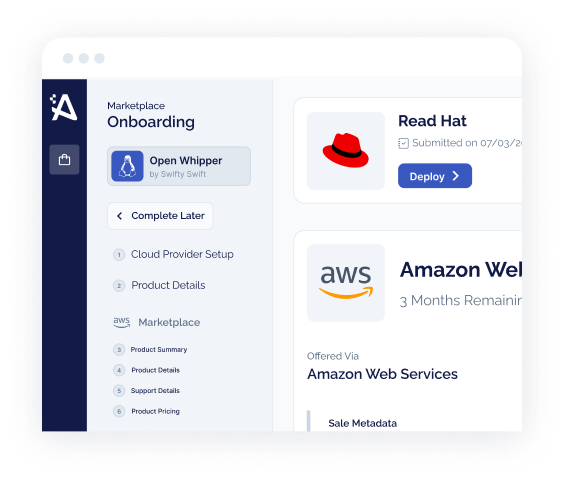
Automatum simplifies GCP Marketplace operations alongside AWS and Azure — listing management, private offers, metering, co-sell tracking, and revenue analytics in one platform.
Book a Working Session →Frequently Asked Questions
Common questions ISVs ask when entering or scaling on GCP Marketplace.
How long does it take to list a product on GCP Marketplace?
Timelines vary by listing type. SaaS and Kubernetes apps typically take 2 to 4 weeks. VM-based listings take 1 to 3 weeks. AI/ML model listings can take 3 to 6 weeks due to the Vertex AI integration review. Plan additional time for the architectural review process.
Do GCP Marketplace purchases count toward Committed Use Discounts?
Yes. GCP Marketplace purchases count toward CUD commitments. This is one of the strongest procurement incentives on GCP, as buyers can deploy already-committed cloud spend on your software rather than allocating new budget.
What deployment models does GCP Marketplace support?
GCP Marketplace supports five deployment models: SaaS (ISV-hosted), Virtual Machine (Compute Engine), Kubernetes App (GKE), AI/ML Model (Vertex AI), and Data Product (BigQuery or Analytics Hub). Each has distinct integration requirements and billing mechanics.
How does GCP co-sell differ from AWS ISV Accelerate?
GCP’s co-sell program is more relationship-driven than AWS’s structured ISV Accelerate program. On GCP, qualifying for active co-sell support depends heavily on your relationship with your Google Cloud partner manager, your Partner Advantage designation, and having a joint go-to-market plan.
Can I list on GCP, AWS, and Azure Marketplace simultaneously?
Yes, and most ISVs should. Each marketplace requires separate technical integration work since the APIs differ, but the commercial and operational concepts are similar. A platform like Automatum can manage all three from a single dashboard.
Keep building your marketplace motion
Guides for multi-cloud marketplace strategy, private offers, and co-sell.