The Number Your Engineering Team Will Quote You
When marketplace listing first comes up at a leadership meeting, engineering's response is usually somewhere between we can do that in a sprint and that is a three-month project. Neither estimate is correct.
What You Are Actually Building
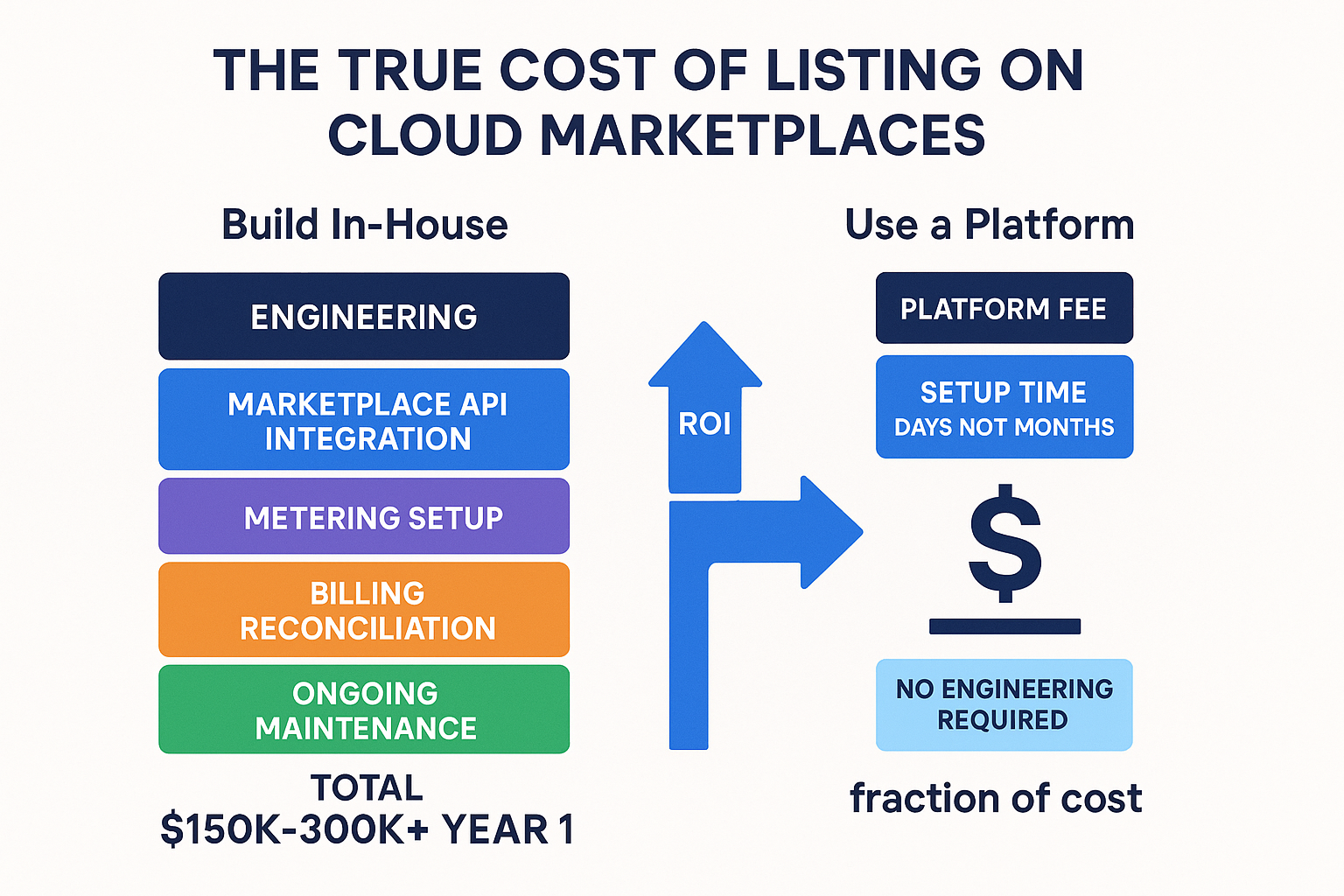
A fully functional, transactable marketplace listing on a single cloud provider requires:
1. Marketplace API Integration
Each cloud provider exposes APIs for subscription management, metering, and entitlement resolution. Each API has its own authentication model and data schemas.
2. Subscription Lifecycle Event Handling
Webhook reliability requires retry logic. Idempotency requires deduplication. Synchronizing marketplace subscription state with your internal state requires careful reconciliation logic.
3. Metering Infrastructure
Usage-based pricing requires you to emit metering records at regular intervals. Building a reliable metering pipeline means infrastructure that is highly available, monitored, and operationally maintained.
4. Private Offer Workflow
You need a way to create Private Offers programmatically, communicate them to buyers, track acceptance, and reconcile subscriptions.
5. Billing Reconciliation
Marketplace providers pay out on net-60 or net-30-45 day cycles in provider-specific formats.
The Engineering Cost Breakdown
Initial Build
Realistic total for a single marketplace: 3–6 months of calendar time, involving 2–3 engineers. At $150–200 per engineer-hour, a 4-month build runs $150,000–$300,000 in engineering spend.
Ongoing Maintenance
0.25–0.5 FTE per year = $60,000–$120,000 annually.
Multi-Cloud Multiply
A three-marketplace integration can cost $350,000–$600,000 in initial engineering investment.
The Opportunity Cost
Delayed Revenue: If your addressable marketplace opportunity is $2M ARR in year one, a 4-month delay represents $667,000 in delayed revenue.
Roadmap Displacement: When engineering spends 3-6 months building marketplace infrastructure, they are not building product features.
Maintenance Distraction: Someone must permanently own metering discrepancies, webhook failures, and API deprecation notices.
The Commission in Context
A 3% commission on $1M in marketplace revenue is $30,000. The engineering cost of building the integration is likely 5–10x that figure in year one. The commission is the price of access to a distribution channel with committed-spend eligibility, co-sell leverage, and global buyer reach.
The ROI Framework
- Identify the percentage of customers with active EDP, MACC, or CUD commitments
- Estimate ACV of deals that benefit from committed-spend eligibility
- Estimate incremental revenue from co-sell referrals
- Compare total in-house cost against platform approach cost
The Automatum Cost Model
Automatum eliminates the entire in-house engineering cost by handling technical integration for AWS, Azure, and GCP. Listing timeline measured in weeks, not months. Zero internal engineering hours. Maintenance stays with Automatum as APIs evolve.
Visit automatum.io to start the conversation about your marketplace opportunity.
No spam. Just the latest releases and tips, interesting articles, and exclusive interviews in your inbox every week.
.svg)