Why Data and Analytics Is the Hottest Marketplace Category
Data and analytics software has become one of the fastest-growing categories on cloud marketplaces, driven by a convergence of enterprise data modernization initiatives and the explosive growth of AI and machine learning workloads. According to IDC, global spending on big data and analytics solutions reached $274 billion in 2025, with a compound annual growth rate of 13.4% projected through 2028. A growing share of this spend is flowing through cloud marketplace channels as enterprises seek to consolidate their data stack procurement under existing cloud commitments.
The category's strength on marketplaces is not accidental. Data and analytics products are inherently cloud-native, often running directly on the buyer's cloud infrastructure and consuming compute, storage, and networking resources that generate additional cloud revenue. This alignment creates a powerful incentive for cloud providers to promote data ISV solutions through co-sell programs, featured placements, and dedicated partner resources. AWS, Azure, and GCP all maintain dedicated data and analytics partner tracks that provide ISVs with enhanced go-to-market support, technical resources, and sales team engagement.
For data and analytics ISVs, cloud marketplaces represent more than just a distribution channel. They are a strategic growth engine that combines access to enterprise committed spend budgets with cloud provider co-sell support. Companies like Databricks, Snowflake, Confluent, and Datadog have demonstrated that marketplace channels can drive significant revenue growth, with some reporting that marketplace transactions account for 20% to 40% of new enterprise bookings. Smaller data ISVs can replicate this success by understanding the unique dynamics of selling data products through marketplaces.
Market Size and Growth Trajectory
The data and analytics marketplace opportunity is substantial and growing. Bessemer Venture Partners reported that cloud marketplace transactions for data and analytics products grew 67% year-over-year in 2025, outpacing the overall marketplace growth rate of 45%. This acceleration is driven by several factors. First, enterprises are consolidating their data stacks onto cloud-native platforms, replacing on-premises ETL tools, data warehouses, and BI platforms with cloud-based alternatives. Second, the AI boom has created urgent demand for data infrastructure, including data quality tools, feature stores, vector databases, and ML pipeline platforms that enterprises need to operationalize generative AI initiatives.
Gartner estimates that by 2027, 60% of enterprise data and analytics software purchases will be transacted through cloud marketplaces, up from approximately 25% in 2025. This shift is particularly pronounced in the data observability, data integration, and analytics engineering subcategories, where cloud-native delivery is the default. For ISVs in these segments, marketplace presence is transitioning from a nice-to-have to a requirement for competing in enterprise deals. Enterprises with large cloud commitments are actively steering purchases toward marketplace channels, and procurement teams increasingly require marketplace availability as part of their vendor evaluation criteria.
Unique Challenges for Data ISVs on Marketplaces
Data Residency and Sovereignty
Data and analytics products handle some of the most sensitive enterprise assets: customer data, financial records, operational metrics, and proprietary business intelligence. Enterprise buyers in regulated industries such as financial services, healthcare, and government have strict data residency requirements that dictate where data can be stored and processed. Data ISVs must clearly communicate their data residency capabilities on marketplace listings, including which cloud regions they support, whether data remains within the buyer's cloud account (BYOA or bring-your-own-account models), and how cross-region data transfers are handled. Listings that fail to address data residency concerns upfront lose enterprise deals to competitors who do.
Compute-Intensive Pricing Complexity
Data and analytics workloads are inherently variable and compute-intensive. A data pipeline that processes 10 GB daily has fundamentally different resource requirements than one processing 10 TB. This variability makes pricing challenging on marketplaces, where buyers expect transparent and predictable costs. ISVs must design pricing models that are simple enough for marketplace listing pages while flexible enough to accommodate the wide range of usage patterns that data products experience. The tension between pricing simplicity and pricing accuracy is one of the defining challenges for data ISVs on marketplaces, and getting it wrong leads to either underpricing (margin erosion) or overpricing (deal loss).
Integration Complexity and Time to Value
Data products rarely operate in isolation. They connect to data sources, orchestration platforms, cloud storage, compute engines, BI tools, and downstream applications. Enterprise buyers evaluate data products not just on standalone capability but on how seamlessly they integrate with their existing data ecosystem. Marketplace listings need to clearly document integration patterns, supported data sources, API specifications, and deployment architectures. ISVs that offer turnkey deployment through AWS CloudFormation, Azure ARM templates, or Terraform modules reduce the time to value and increase conversion rates from marketplace listings to active customers.
Pricing Models That Work for Data ISVs
Selecting the right pricing model is one of the most consequential decisions a data ISV makes when listing on cloud marketplaces. The model must align with how customers derive value from the product, be simple enough for marketplace listing pages, and generate predictable revenue. The following table summarizes the most effective pricing models for data and analytics products, along with their strengths and considerations.
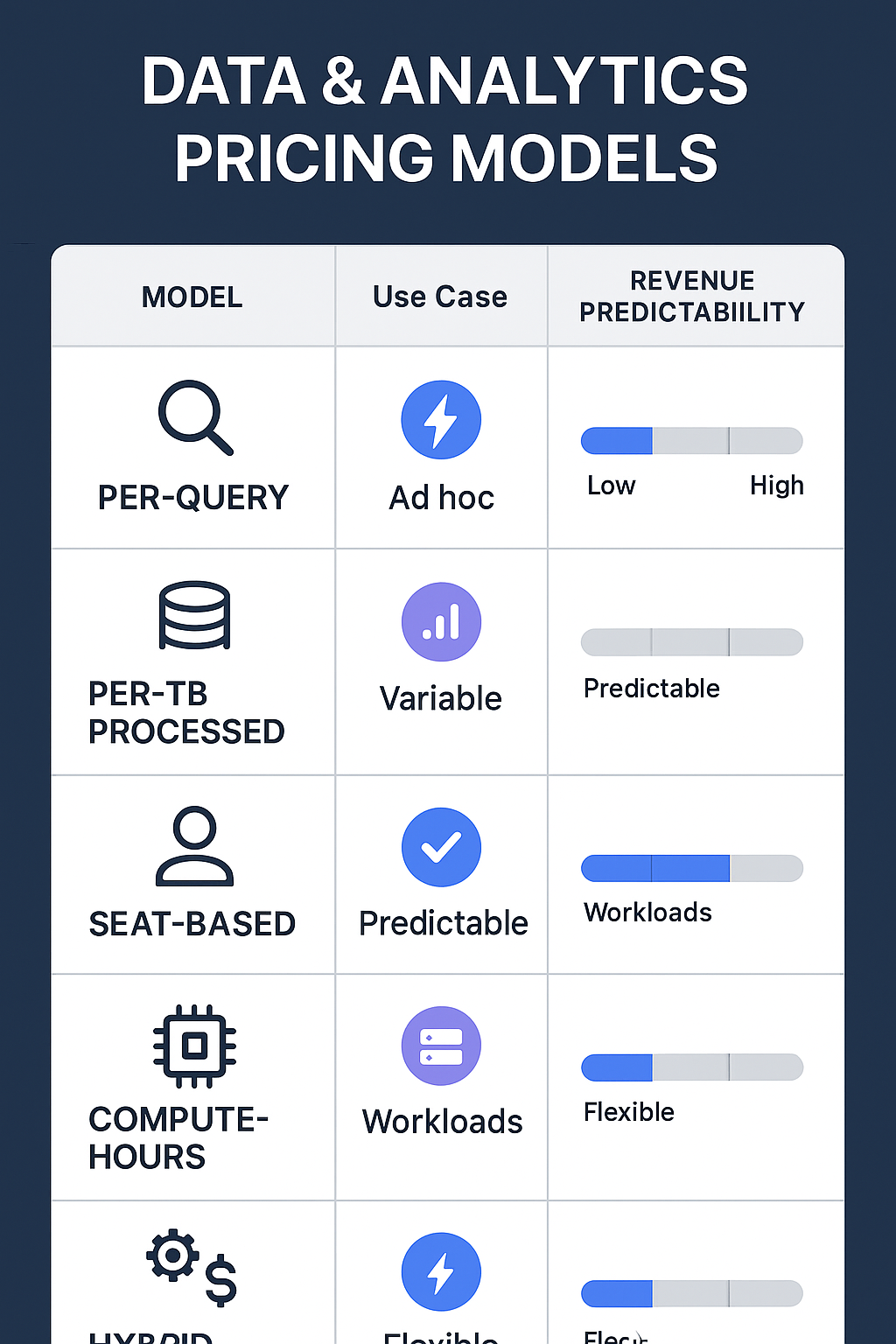
| Pricing Model | Best For | Marketplace Compatibility | Buyer Preference | Revenue Predictability |
|---|---|---|---|---|
| Per-query or per-job | Analytics engines, data processing tools | High (metering API supported) | Medium (variable costs concern some buyers) | Low to medium |
| Per-TB processed or stored | Data warehouses, lakes, ETL tools | High (metering API supported) | High (correlates to data volume growth) | Medium |
| Per-seat or per-user | BI platforms, data catalogs, analytics dashboards | High (contract-based) | High (predictable and familiar) | High |
| Platform fee + usage | Full-stack data platforms, multi-service offerings | Medium (requires hybrid contract + metering) | High (base cost with variable upside) | Medium to high |
| Compute credits or units | Elastic compute platforms, serverless data tools | High (metering API supported) | Medium (requires credit-to-value mapping) | Medium |
| Annual subscription tiers | Data quality, governance, observability tools | High (contract-based) | High (simple, predictable) | High |
Choosing the Right Model
The best pricing model depends on three factors: how customers use the product, what competitors charge, and what the marketplace platform supports technically. For products with highly variable usage patterns such as data processing engines or analytics platforms, usage-based models (per-query, per-TB, or compute credits) align cost with value and reduce the barrier to initial adoption. However, enterprise procurement teams often prefer predictable costs, which is why many successful data ISVs offer a hybrid approach: an annual platform fee that includes a baseline usage allocation, with metered overage charges for consumption beyond the baseline.
For products with more predictable usage patterns such as data catalogs, governance tools, or BI platforms, annual subscription tiers based on seat count or data volume provide the simplicity and predictability that enterprise procurement teams prefer. These models map cleanly to marketplace contract structures and are straightforward for buyers to evaluate against budget. ISVs should also consider offering a free tier or trial through the marketplace to lower the barrier to evaluation. Data products often require technical proof-of-concept work before a purchase decision, and marketplace free trials enable this without engaging procurement.
Technical Integration Patterns for Marketplace Success
SaaS Delivery with Marketplace Billing
The most common integration pattern for data ISVs is SaaS delivery with marketplace billing. The ISV hosts and operates the product in their own cloud infrastructure, and the buyer accesses it through a web interface or API. The marketplace handles billing, and the ISV uses the marketplace's SaaS fulfillment APIs to provision accounts, track subscriptions, and report usage. This model is straightforward for ISVs to implement but requires careful attention to data residency and security, as data flows from the buyer's environment to the ISV's infrastructure. AWS SaaS Subscriptions, Azure SaaS offers, and GCP SaaS listings all support this pattern.
Container-Based Deployment in Customer VPC
For data ISVs whose customers require data to remain within their own cloud accounts, container-based deployment in the customer's VPC (Virtual Private Cloud) is an increasingly popular pattern. The ISV packages their product as container images, which the buyer deploys into their own cloud account using marketplace-provided deployment templates. The ISV retains the ability to push updates and monitor health through control plane access, while the data plane remains entirely within the buyer's environment. This pattern addresses data residency concerns and is well-supported by AWS Marketplace Container listings, Azure Container offers, and GCP Marketplace Kubernetes applications.
AMI and Machine Image Listings
Some data ISVs, particularly those offering databases, data warehouses, or specialized compute engines, list as machine images (AMIs on AWS, VM images on Azure, or custom images on GCP). The buyer launches the image in their own cloud account and manages the infrastructure. This model provides maximum data isolation and control but shifts operational responsibility to the buyer. It works best for products that appeal to technically sophisticated teams who prefer self-managed deployments. ISVs should provide comprehensive deployment documentation, infrastructure-as-code templates, and monitoring dashboards to support this model.
Co-Sell Strategies Specific to Data Workloads
Align with Cloud Provider Data Initiatives
Cloud providers invest heavily in data and analytics ecosystems because data workloads drive significant cloud consumption. AWS promotes its analytics stack (Redshift, Glue, Athena, EMR), Azure pushes Microsoft Fabric and Synapse, and GCP champions BigQuery and Dataflow. Data ISVs that position their products as complementary to these first-party services rather than competitive with them unlock co-sell support. For example, a data quality ISV that integrates with Amazon Redshift and AWS Glue can co-sell alongside AWS's analytics team, who recommend the ISV's product as part of a complete data stack. Frame your value proposition as extending the cloud provider's data platform rather than replacing it.
Target Migration and Modernization Deals
Enterprise data migration projects represent enormous co-sell opportunities. When enterprises migrate from on-premises data warehouses like Teradata, Oracle Exadata, or IBM Netezza to cloud-based alternatives, they need a full ecosystem of tools for ETL, data quality, cataloging, observability, and analytics. Cloud providers have dedicated migration teams and programs such as AWS Migration Acceleration Program (MAP) and Azure Migrate that actively seek ISV partners to support these initiatives. Data ISVs should register with these migration programs, create migration-specific solution briefs, and build relationships with cloud provider migration specialists who can introduce them to active migration deals.
Leverage AI and ML Use Cases
The generative AI wave has created urgent demand for data infrastructure that supports AI/ML workloads. Enterprise AI initiatives require clean, well-governed data, which means data quality, integration, cataloging, and observability tools are prerequisite purchases. Cloud providers recognize this dependency and are eager to co-sell data infrastructure alongside their AI/ML services (Amazon SageMaker, Azure OpenAI Service, Google Vertex AI). Data ISVs should create AI-specific solution briefs that demonstrate how their product enables enterprise AI initiatives, and register co-sell opportunities that tie data infrastructure purchases to AI project timelines.
Case Studies: Data ISVs Succeeding on Marketplaces
Observability Platform Scaling Through AWS Marketplace
A mid-market data observability platform listed on AWS Marketplace in early 2024 with annual subscription pricing starting at $50,000. Within 12 months, marketplace transactions represented 35% of their new enterprise bookings. The key to their success was threefold. First, they aligned their listing with AWS's data quality and observability messaging, securing co-sell support from AWS's analytics specialist team. Second, they pre-approved discount ranges for private offers, enabling their sales team to generate offers within hours rather than days. Third, they offered a 14-day free trial through the marketplace, which allowed technical evaluators to build internal business cases with real data before engaging procurement.
Data Integration ISV Capturing Azure MACC Spend
A data integration company that primarily served AWS customers expanded to Azure Marketplace specifically to capture Microsoft Azure Consumption Commitment (MACC) spend. They listed with a hybrid pricing model: an annual platform fee of $120,000 plus per-TB metering for data processed above the included baseline. Within six months, they closed three enterprise deals totaling $1.2 million, all funded through MACC drawdowns. The deals closed 40% faster than their typical direct sales cycle because procurement teams were motivated to deploy committed spend before quarter-end deadlines.
Analytics Platform Leveraging Multi-Cloud Listings
A business analytics platform that had been listed exclusively on AWS Marketplace expanded to all three major marketplaces using a management platform to synchronize listings, pricing, and private offers. The multi-cloud strategy increased their addressable market by 60% and allowed them to compete in enterprise deals where the buyer's committed spend was on Azure or GCP rather than AWS. By maintaining consistent pricing and feature parity across all three marketplaces, they eliminated a common objection from enterprise procurement teams: that the product was only available on a single cloud, creating vendor lock-in concerns.
Building Your Marketplace Go-to-Market Strategy
Phase 1: Foundation (Months 1-3)
Start by listing on the marketplace where your largest customer base already operates. For most data ISVs, this is AWS Marketplace. Create a comprehensive listing with clear pricing, detailed integration documentation, and prominent compliance certifications. Implement marketplace billing integration using the provider's SaaS fulfillment APIs. Train your sales team on marketplace mechanics, particularly how to create and manage private offers. Set up internal processes for private offer approval, customer provisioning, and usage reporting. Establish baseline metrics: conversion rate from listing views to free trials, trial-to-paid conversion rate, and average deal size.
Phase 2: Optimization (Months 3-6)
With your first marketplace live, optimize based on data. Analyze which pricing tiers convert best and adjust your public pricing accordingly. Build a library of pre-approved private offer templates for common deal structures. Engage with the cloud provider's partner team to register for co-sell programs and submit your first co-sell opportunities. Create marketplace-specific sales collateral including ROI calculators, migration guides, and competitive comparison sheets. Begin planning your expansion to a second marketplace based on where your pipeline shows the most committed spend opportunity.
Phase 3: Scale (Months 6-12)
Expand to additional marketplaces, ideally using a unified management platform to maintain consistency across channels. Deepen co-sell relationships by attending cloud provider partner events, publishing joint case studies, and participating in marketplace promotional programs. Implement advanced marketplace features such as metering for usage-based pricing, multi-year private offers for large enterprise deals, and channel partner private offers (CPPO on AWS, MPO on Azure) to enable reseller partnerships through the marketplace. Track marketplace-sourced revenue as a distinct channel and set growth targets accordingly.
Accelerate Your Marketplace Strategy with Automatum
Managing data and analytics listings across multiple cloud marketplaces involves significant operational complexity: maintaining consistent pricing, generating private offers for enterprise deals, tracking metering data, and coordinating co-sell opportunities across cloud provider partner teams. Automatum simplifies this by providing a single platform to manage your entire marketplace presence. Create and update listings on AWS, Azure, and GCP from one dashboard. Generate private offers in minutes with pre-approved pricing templates. Track usage metering and revenue analytics across all channels. Coordinate co-sell opportunities with cloud provider partner teams through integrated pipeline management. For data and analytics ISVs ready to scale their marketplace business, Automatum eliminates the operational overhead so your team can focus on building great products and closing deals. Visit automatum.io to see how leading data ISVs are growing their marketplace revenue with less operational burden.
No spam. Just the latest releases and tips, interesting articles, and exclusive interviews in your inbox every week.
.svg)